Self-service scanning
Point checkii at code and sites you have proven you own. Source, secret and infrastructure-as-code scanning, plus web pentests on paid plans. Free tier included, bounded rather than unlimited.
checkii.ai is the control plane for security work that has to be proven afterwards: authorised penetration testing, defensive operations, AI governance and the SOC 2, ISO 27001 and GDPR assurance records, all in one hosted console. Every action runs inside a verified, approved, signed scope and leaves a sealed record. Built for consultancies, MSPs and regulated teams who have to show their working.
Self-service scanning brings work in. The authorised-testing control plane is where consultancies and MSPs run client engagements. The governance workspace turns the same activity into regulator-facing evidence.
Point checkii at code and sites you have proven you own. Source, secret and infrastructure-as-code scanning, plus web pentests on paid plans. Free tier included, bounded rather than unlimited.
Signed scope, independent approval, per-client tenants, private worker pools, sealed evidence bundles and client reports in markdown, PDF, DOCX, CSV, JSON and SARIF. This is what a consultancy sells to its own clients.
Model inventory, capability evaluation and policy gates, with EU AI Act and ISO/IEC 42001 artefacts drawn from live activity. Beside it, three assurance sections in the same console: an Audit & Assurance workspace for SOC 2 and ISO/IEC 27001 readiness, privacy records for the EU and UK GDPR, and trust assurance that collects signed control observations to show a customer. Sold with the control plane. Monitoring and detection ship with self-hosting, with no claims attached.
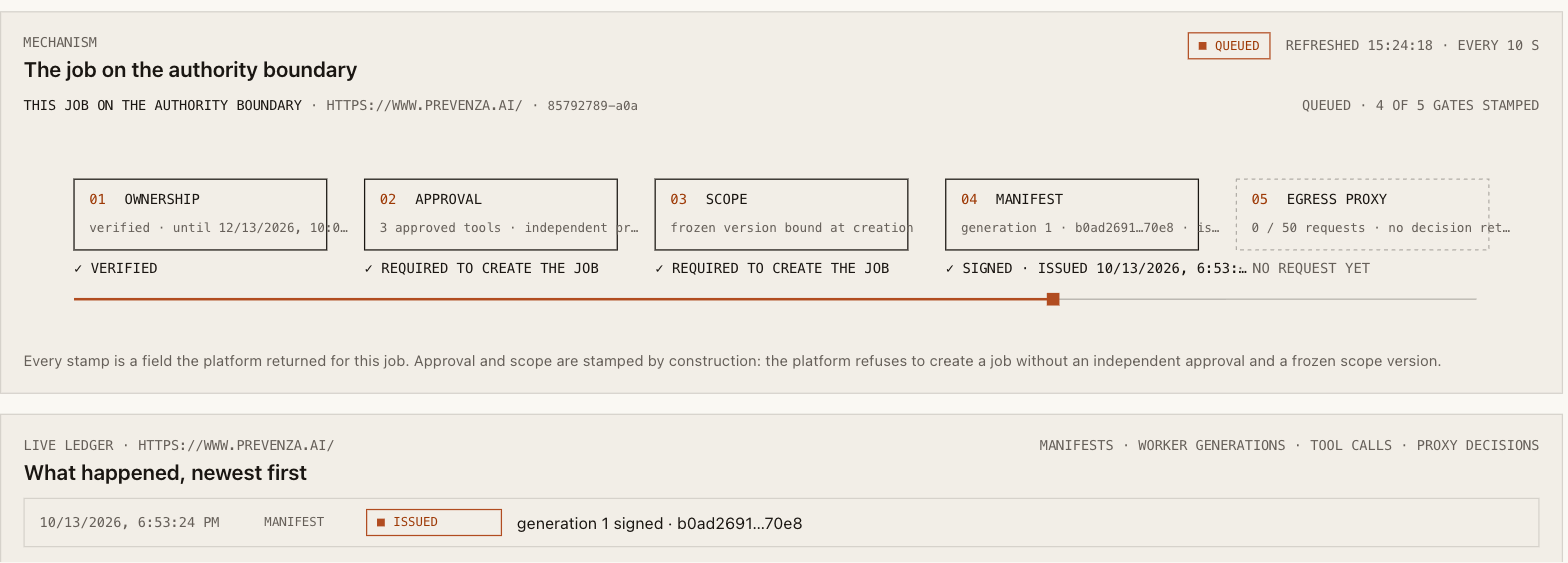
Written authorisation, executor-verified ownership, an immutable scope version, then a signed manifest executed through an enforcing egress proxy. Every step is a record. How a job gets authorised
| Capability | What it does | Status |
|---|---|---|
| Self-service web pentests | Checkii Native, the agent-driven pentest engine, with the HTTP baseline in the same run on all plans and the checkii HTTP bundle added on Pro and Studio, against a site or API you have proven you own. Target verification and independent approval before execution. A paid plan accepts the request today; execution opens when Checkii Native is released to customer traffic, and no allowance is used until then. | Requests accepted · execution not yet released |
| Source assessments | SAST (Semgrep), dependencies and IaC (Trivy), secrets (gitleaks), SBOM with licences, on the exact commit you name. Read-only, on a repository verified through the checkii GitHub App. | Hosted · runs today |
| Validation scenarios | Catalogue scenarios executed in the isolated lab against synthetic fixtures, returned as a lab-signed evidence envelope. | Hosted · Pro and Studio |
| Container image scanning | A sealed archive upload and an offline Trivy job for an authorised engagement, through the assessment console or the API. Runs in the shared-supervisor worker, a recorded deviation from the isolated plane. The self-service page cannot start one from an image reference yet. | Hosted · console upload |
| Active engine against customer estates | Playwright, Nuclei, OWASP ZAP, OpenAPI, GraphQL (contract, authorisation and complexity) and authenticated Postman through a DNS-pinned egress proxy with per-hop re-authorisation and rate budgets. Qualified against the synthetic lab. Ships against customer estates after the Phase 3 containment gate clears. | Built · gated |
| Checkii Native, the AI engine | A model-driven pentest engine on a dedicated executor, every target request through the governed proxy under the same signed manifest, model calls budgeted and logged. Qualified on its dedicated executor in the hosted lab: the authorisation chain, executor identity, model path and target traffic through the proxy have each been exercised and recorded. Not yet released to customer traffic; the remaining items are containment and recovery work on the hosted cluster rather than engine work. Not sold as complete until it is. | Qualified in the lab · not yet released |
| OSINT with recorded authority | Web search and page fetches for reconnaissance run through a gateway that records the authority they ran under; transcripts are sealed before use. | Built · gated |
| Findings and reports | Cross-job dedup, human review with expiring risk acceptance, retest lineage, reports in Markdown, JSON, CSV, SARIF, PDF and DOCX with provenance. | Runs today |
Exit gates: the Phase 0 governance baseline was signed on 2026-09-08 by an independent approver and is Sigstore-verified in CI. Phase 3 containment approval is still required before the broader active engine touches a customer estate.
Vulnerability and asset management, ML intrusion detection, a SIEM, and analyst agents that read and draft but structurally cannot approve, block or execute. Detection benchmark
| Service | What it does | Status |
|---|---|---|
| Vulnerability & asset managementCheckii VM · :8000 | CVE, EPSS and CISA KEV correlation with contextual risk scoring across your inventory. It correlates; it does not exploit. | Hosted · console, read-only · by quote |
| ML intrusion detectionCheckii IDS · :8100 | Flow classification enriched with asset context; PSI drift monitoring raises a SIEM alert when traffic leaves the training distribution. Each source’s hour is scored against its own baseline, with reasons an analyst can check by hand, and analyst feedback is kept for retraining. | Hosted · console, read-only · by quote |
| SIEM & remediationCheckii Platform · :8200 | API-driven ingestion of auth, firewall and CloudTrail events, correlation alerts, UEBA baselines. Analyst verdicts on every alert give each rule a measured false-positive rate and triage time; alerts are grouped into incident candidates by the users, addresses and indicators they share; log sources are reported when they go silent or fall below their usual volume. Remediation tickets move from open to approved to done, with audit, and approved work is handed to your tracker by the integration relay. The remediation path. | Hosted · console, read-only · by quote |
| Analyst agentsCheckii Agents · :8300 | Triage, ticketing, hunt and reporting agents that correlate and draft. Advisory only, by construction of their client code. Every model call is redacted, authorised and recorded per tenant before it is made; a refusal means no call. | Hosted · console, read-only · by quote |
| Sensors and collectors | Nothing ships flows to the IDS or logs to the SIEM on your behalf. You connect your own sensors and forwarders to the ingest APIs. | Bring your own |
The IDS benchmark as we ran it, failures included. Read it as a ceiling for a model trained on your own sensor traffic. It is not a promise about ours.
| Evaluation | Detection |
|---|---|
| In-distribution real (CICIDS2017, held-out) | 0.988 |
| In-distribution real (each IDS2018 day on itself) | 1.000 |
| Cross-year, same family: DoS | 0.999 |
| Cross-year, same family: brute-force | 0.51 |
| Cross-year: botnet | 0.002 |
| Synthetic-trained, tested on real traffic (four of five pairs) | 0.0 – 0.12 |
| Synthetic-trained, tested on real traffic (IDS2018 DoS day, the outlier) | 0.96 |
Near-perfect on the distribution it was trained on; cross-year transfer works only for families that look alike; synthetic to real collapses. That is the honest reason to retrain on your own sensor traffic, and the ingest loop ships in the box. Measured by one hand-run pass of python -m ids.benchmark on CICIDS2017 and CSE-CIC-IDS2018, recorded in services/ids/BENCHMARK.md; not reproduced in CI, no live-capture evaluation yet.
A tenant-scoped register of AI systems and risks, control assessments that collect evidence from what the platform actually did, and the obligation artefacts an EU AI Act or ISO/IEC 42001 programme is built on. Next to them, the three assurance sections of the console: SOC 2 and ISO/IEC 27001 readiness workpapers, the records a GDPR controller or processor must hold, and signed control observations you can show a customer. For compliance & risk teams
| Function | What it does | Status |
|---|---|---|
| System & risk register Know what AI you run, and its riskCheckii Governance · :8400 | AI systems, EU AI Act tier, owners, lifecycle and review dates; risks with inherent and residual scores mapped to a control framework catalogue. | Hosted · console |
| Control assessments Evidence from live activityCheckii Governance · :8400 | Assessments auto-collect evidence from live platform activity through a service identity, so a control shows the events that prove it operated. | Hosted · console |
| Obligation artefacts EU AI Act timelines & Art. 11 docsCheckii Governance · :8400 | EU AI Act obligation timelines and Article 11 technical-documentation skeletons generated from your own register. | Hosted · console |
| Tamper-evident record Audit chains & encrypted evidenceCheckii Platform · :8200 | Per-tenant HMAC audit chains with external, versioned keys; AES-256-GCM envelope-encrypted evidence with hold-aware retention. Purged content returns HTTP 410 with custody metadata retained. | Hosted · platform |
| Audit & Assurance SOC 2 and ISO/IEC 27001 readinessCheckii Platform · :8200 | Programmes with a frozen scope, owner and as-of date or period. Your own controls, referenced to SOC 2 criteria, ISO/IEC 27001:2022 and ISO/IEC 42001:2023; a Trust Services Criteria catalogue and a Statement of Applicability generated from them. Retained documentary evidence, a risk register where only the named owner may accept a risk, AI impact assessments reviewed by a second person, and governance evidence linked by reference. Workpapers are disposed of as whole programmes after independent approval. | Hosted · console |
| Privacy records EU GDPR and UK GDPR recordsCheckii Platform · :8200 | Processing activities with the regime you assert applies, sub-processors, impact assessments reviewed by a second person, rights requests with their arithmetic deadlines, and breach records: each a revision-chained assertion, hash-verified on read. A subject export is a custody record; the export body is returned once and never stored. An erasure job, once approved and past its grace period, pseudonymises the subject's tenant-local contact data and issues a receipt. The platform account, the audit chain and data held in your other systems are outside it and remain yours to handle. The platform never decides lawfulness and notifies nobody. | Hosted · console |
| Trust assurance Signed control observations for customersCheckii Platform · :8200 | Collectors you register, and a second person approves, submit Ed25519-signed observations of named checks: today, GitHub branch protection and secret scanning, AWS S3 public-access block and default encryption. Controls carry a freshness window; a claim you propose is reviewed before a customer sees it, is cited in questionnaire answers, and is withdrawn when its evidence expires. Customers read it through an expiring access code. On the hosted beta, sources, controls and collection were proven on 12 October 2026; customer claims, shares and questionnaires are exercised in the release qualification on every change, but have not yet been run for a customer on the hosted cluster. | Hosted · console, point-in-time attestation |
Self-healing remediation. What is offered is the governed path: agents draft, an independent human approves, your engineers or the owning system do the work, a retest closes it. How remediation works
One detection accuracy figure. Off its training distribution the IDS degrades. We show it and ship the retrain loop.
The governance score and the assurance workpapers. They record declared control status and prepare the paperwork. The auditor issues the SOC 2 report, the certification body certifies, your counsel judges lawfulness.
A 24/7 SOC or endpoint agent. This is a transparent, self-hostable base you control.
You have to demonstrate control over your AI systems and security posture, and the proof usually lives in stale spreadsheets. checkii generates it as you work.
Keep the register current; generate obligation timelines and Article 11 skeletons. Arrive with the paperwork pre-structured.
Assessments auto-collect evidence from live activity. Backed by real events rather than a checkbox ticked last quarter.
Forced-RLS isolation, envelope-encrypted evidence, tamper-evident audit chains. A defensible chain of custody.
Region-bound retention, legal holds, approved deletion. Purged content returns HTTP 410; custody metadata retained.
Record your controls against the criteria, attach the documents, treat the risks, and let the workspace generate the Trust Services Criteria catalogue and the Statement of Applicability. The auditor receives workpapers, not a checklist you typed the week before.
Processing activities, sub-processors, impact assessments, rights requests and breach records, each a revision-chained assertion with a second reviewer where the regulation expects one. Deadlines are computed from the dates you record; the judgement stays yours.
Collectors observe your GitHub and AWS configuration and sign what they saw. Reviewed claims cite those observations, and a customer reads them through an expiring access code. Built and qualified; not yet used with a customer on the hosted beta. A claim is withdrawn the moment its evidence goes stale.
Defensive and offensive share identity, tenancy, evidence and governance through one control plane, while their executable workers and network paths stay isolated.
Select a node to see what it may reach. Paths come from the network-policy manifest applied to the hosted cluster on 6 October 2026; "verified" means a connection was attempted from inside the live pod that day.
Register, risk register and control assessments for the EU AI Act and ISO 42001, evidence collected from live activity; SOC 2 and ISO/IEC 27001 workpapers, GDPR records and customer-facing trust assurance in the same console.
Every job bound to an approved tenant, scope, verified asset, tool and network path by policy code. You can prove what the tool was allowed to do.
The agents read, correlate and draft, and structurally cannot approve, block or execute. The guarantee lives in the client code.
Offensive workers run behind an enforcing egress proxy in their own plane; defensive services never share a network path with them. On the hosted cluster this is enforced by network policy and verified by probes from inside the live workloads: each worker class reaches only its own services, instance metadata is unreachable, and the defensive plane admits nothing from the offensive one.
The same ledger that drives your operators is the evidence your auditors sign off on, with nothing re-collected and nothing missing.
checkii does not patch, block or isolate anything on its own. It runs the governed path around the fix: a drafted ticket or patch, an independent approval, a hand-off to the people or the system that own the change, and a separately authorised retest that closes the finding on evidence.
The ticketing agent turns high-risk findings and open alerts into tickets with a recommended fix, a suggested owner and a due date, and for tickets raised from IDS alerts the triage loop appends its evidence to the note before anyone opens it. For code, a remediation-mode job proposes a unified diff to existing files on a temporary branch; it cannot create, delete, rename or merge. The agents' client code can create and annotate. It has no method to approve, assign or close.
A security approver who is not the ticket's author approves it, or rejects it as accepted risk. A proposed patch gets an independent review and a separate security review before it can be published. Every transition is audited and idempotent; the audit chain is per tenant and HMAC-sealed.
Approved tickets are queued in a transactional outbox and delivered by an isolated relay to Jira, GitHub, GitLab or Azure DevOps issues, or to a signed webhook. A reviewed and tested patch is published as a draft pull request on GitHub, the one provider the patch path supports today, which the relay creates and nobody at checkii merges. Your engineers, or the system that owns the asset, do the work.
Only a done ticket with an independent approver can be retested, by a new assessment job linked before it starts and bound to the same tenant, finding and scope. The outcome is recorded against the original finding with its evidence, and a retest report carries that lineage. A finding closes on a fresh result, not on a status change.
Drafting, approval, hand-off and retest, in the Remediation and Integrations sections of the hosted console.
Self-healing. No automatic patching, blocking, isolation or merge. The guarantee lives in the agents' client code and in the relay's fixed set of provider calls.
Run checkii entirely inside your network perimeter. Define the approved scope, connect your security stack, and keep sensitive telemetry under your control.
No required outbound calls. Telemetry stays on your hardware.
Actions outside the approved scope are blocked outright; there is no warning mode.
Deployment review, scope design, and a guided platform walkthrough.
Request a demoProve ownership once, with a well-known file on the site or the checkii verification app on the repository, and the hosted platform runs the assessment: signed manifest, egress-enforced worker, findings with remediation guidance. Start free with source scanning, then pay only when you need active testing. Running for customers today: SAST, SCA, secret scan, IaC, SBOM and validation scenarios. Web pentest requests are accepted on every plan and queue until Checkii Native is released to customer traffic; no allowance is used until a pentest runs. Container image scanning runs for authorised engagements through the console's archive upload; the self-service image-reference route is not wired yet.
After payment we provision your workspace by hand and email your sign-in details, within two working days. Payment unlocks requests; it never starts a scan.
Already subscribed? Open your workspace · Sign in to the console
For one repository and one verified domain. No card.
For a project shipping continuously, plus synthetic detection exercises.
For a team running assessments across several projects.
Billed monthly by Stripe. To cancel or change a plan, email info@checkii.ai; there is no self-service billing portal yet. Your plan includes a set number of authorised, read-only assessments each month against repos or targets you own. Testing systems you do not own needs the authorised-testing control plane: written authorisation, asset verification, and the containment exit gate.
Enter your details and choose a route. Self-service subscriptions include source assessments and tier-based web pentest requests. Payment enables requests; it does not start a scan. Web pentests require target verification and independent approval in the assessment workspace before execution; source assessments require repository verification through the checkii verification app and then run on the commit you choose, with no approval step because nothing is sent to your systems. Offensive testing needs written authorisation and asset verification, so it opens an authorisation request. Nothing runs until it clears, and no payment is taken for it here.
Source scanning is commodity, so it is free within a monthly ceiling. Active testing, evidence bundles, retests and client tenants consume real capacity, so those are what you pay for.
Team and MSP plans are delivered in the hosted console at console.checkii.ai: scope, authorisation, testing, results, operations, governance with its Audit & Assurance, privacy-records and trust-assurance sections, and the read-only defensive views, in one tenant we provision for you. Self-service plans sign in to the same console with a narrower set of sections.
Source, secret and infrastructure-as-code scanning against assets you have proven you own, up to a monthly scan ceiling with standard queue priority, plus one baseline web pentest kind against a verified target, approval required. No card, no client tenants.
A deployment engagement, by quote: all services and the same console, single tenant, in your own cluster. Defensive SOC and governance, the authorised-testing control plane, community support. There is no self-serve installer yet; we deploy it with you.
Your own tenant in the hosted console, provisioned by us: forced-RLS multi-tenancy, SAML, OIDC and SCIM single sign-on, envelope encryption with a per-tenant key rotated under dual control, EU AI Act and ISO/IEC 42001 artefacts, the SOC 2 and ISO/IEC 27001 audit workspace, GDPR privacy records and trust assurance, priority support.
The hosted console with one isolated tenant per client, delegated access across them from your own, private worker pools, multi-format client reports, the audit workspace, privacy records and trust assurance in each client tenant, dedicated support. Priced per client tenant, because that is how you bill.